
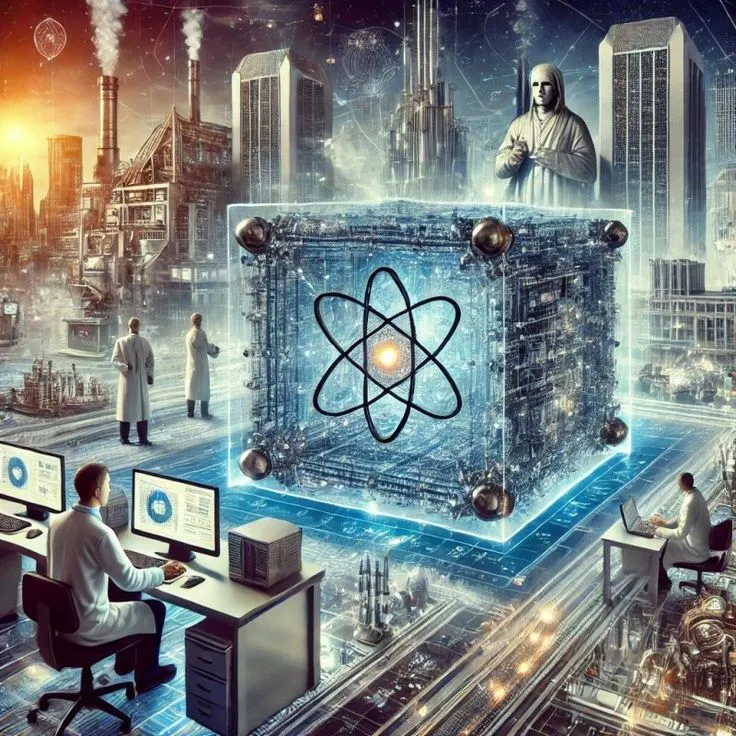
The Quantum Age: October 2025’s Top Tech & Science Breakthroughs
Module 1: The Quantum-AI Revolution and Computational Supremacy
The most disruptive force in technology in October 2025 is the accelerating convergence of Artificial Intelligence (AI) and Quantum Computing. We are moving from the theoretical age of quantum mechanics to the practical Quantum Age. This module explores the latest advancements that are redefining computational power globally.
1.1 The Hybrid Quantum-Classical Leap (Keywords: Quantum Computing, AI, Hybrid, Data Clustering)
Quantum Computing is no longer a niche research field; it’s a co-pilot for AI. The most significant breakthrough this week is the advancement of Hybrid Quantum-Classical AI Models. These models strategically divide labor: complex, resource-intensive tasks like advanced data clustering and optimization are offloaded to quantum computing components, while traditional hardware handles the rest. This hybrid approach is overcoming the inherent limitations of both fields, creating systems capable of analyzing massive, complex data sets far faster than ever before. This is a game-changer for drug discovery, material science, and financial modeling. The efficiency gained by quantum computing accelerates the training of foundational AI models, driving the entire ecosystem forward. The promise of quantum-accelerated machine learning is quickly becoming a commercial reality in this Quantum Age.
1.2 The AI Infrastructure Arms Race and Governance (Keywords: AI, GPU, Foundation Models, Regulation, Safety)
The performance of large language models (LLMs) and multimodal AI systems—known as Foundation Models—continues its rapid ascent. This advancement is fueled by an intense global AI infrastructure arms race. Companies are forming massive partnerships to deploy huge clusters of high-performance GPU accelerators. This buildout is essential for training the next generation of AI capable of handling text, vision, and audio simultaneously. The cost and energy consumption of these systems are driving intense public debate and increasing the urgency for Regulation. In October 2025, regulatory bodies are focused on AI Safety, particularly the integrity of clinical AI devices, demanding clear protocols to monitor performance drift over time. The question of whether advanced AI should be a proprietary tool or a common good for humanity is a foundational governance challenge defining this phase of the Quantum Age.
Module 2: Cosmic Frontiers: New Worlds and Mars Exploration
Space exploration in October 2025 is characterized by the discovery of potentially habitable exoplanets and the strongest evidence yet regarding ancient life on Mars.
2.1 Searching for Habitable Worlds (Keywords: TRAPPIST-1e, Webb Telescope, Atmosphere, Exoplanet)
The Webb Telescope (JWST) remains an unparalleled tool for astrophysics. A major revelation this month is the detection of hints of an Atmosphere on TRAPPIST-1e. This is the first Earth-sized Exoplanet discovered in the habitable zone of its star to show such a distinct atmospheric signal. The implications are profound: we are closer than ever to confirming the atmospheric composition of worlds that could potentially support life. The continued analysis by the Webb Telescope of the TRAPPIST-1e Exoplanet system demonstrates the power of current space technology to answer fundamental questions about our place in the universe. Each new data point from the Webb Telescope moves us closer to a new Quantum Age understanding of the cosmos.
2.2 Unlocking Mars’s Ancient History (Keywords: Mars, Perseverance, Biosignatures, Jezero Crater)
On the surface of Mars, the Perseverance rover is delivering game-changing data. Analysis of rock samples from Jezero Crater—an ancient Martian lakebed—shows mudstones rich in organic-linked minerals. Specifically, the presence of iron-phosphate and iron-sulfide nodules suggests geological processes highly similar to those associated with microbial activity on early Earth. While not conclusive proof of ancient Martian life, these are the strongest Biosignatures detected so far. The ongoing mission of Perseverance is systematically dismantling previous assumptions about the Red Planet’s history, focusing the debate on whether life once thrived in the waters of Jezero Crater. The scientific community is now preparing for a massive push to retrieve and analyze these Perseverance samples back on Earth.
2.3 Powering the Next Leap in Space (Keywords: Rocket Fuel, Energy Density, Manganese Diboride)
Driving the next era of deep space travel requires breakthroughs in propulsion. Scientists have recently unveiled Manganese Diboride, a new boron-rich compound with remarkably high Energy Density. This compound promises to serve as a Rocket Fuel that can deliver an estimated 150% more energy than existing solid materials. This is a critical development for maximizing payload capacity and minimizing travel times for crewed missions to the Moon and Mars. Furthermore, the continued development of technologies like Blue Alchemist, which aims to produce Rocket Fuel and other resources directly from Moon regolith, demonstrates a commitment to establishing sustainable, self-sufficient bases, making the exploration goals of this Quantum Age achievable.
Module 3: Medical and Biotechnological Innovation
The pace of progress in medicine is accelerating, powered by AI and genetic engineering, offering new hope for treating chronic and complex diseases in this Quantum Age.
3.1 New Frontiers in Cancer Metabolism (Keywords: Cancer, T Cells, Ant2 Protein, Immunotherapy)
A significant advance in Cancer treatment involves Metabolic Reprogramming. Researchers have found that by blocking the Ant2 Protein, they can effectively supercharge the body’s T Cells. The Ant2 Protein typically regulates the energy generation of T Cells; blocking it makes these critical immune cells more resilient, faster-acting, and deadlier against tumors. This discovery opens a powerful new pathway for Immunotherapy, shifting the focus from simply boosting the immune system to actively reprogramming its cellular energy efficiency to more effectively fight Cancer. This precision targeting of the Ant2 Protein represents a crucial evolutionary step in modern Immunotherapy.
3.2 AI-Powered Diagnostics and Cellular Breakthroughs (Keywords: AI, Diagnostics, Long COVID, Skin Cells)
AI is becoming indispensable in medical Diagnostics. A new AI tool, DOLPHIN, is capable of uncovering hundreds of invisible genetic markers within single cells. This level of precision promises earlier detection and truly personalized medicine for diseases like Cancer. Furthermore, breakthroughs in understanding chronic conditions are emerging: specialized brain imaging has identified a potential biomarker for Long COVID brain fog, providing the first concrete biological basis for a condition that has long been mysterious. In reproductive science, a major milestone was reached as scientists successfully generated human egg cells from adult Skin Cells in a lab setting, a foundational discovery that could reshape future fertility treatments in this Quantum Age.
3.3 The Regulatory Challenge of AI in Healthcare (Keywords: Medical Devices, Regulation, Data Drift, Safety)
As the integration of AI into Medical Devices accelerates, so does the scrutiny. Regulators are deeply concerned about Data Drift—the phenomenon where an AI model’s performance degrades in real-world clinical settings over time. The FDA is actively seeking industry feedback on how to ensure the long-term Safety and efficacy of these Medical Devices. This Regulation is essential because, unlike traditional hardware, AI‘s performance is dynamic. Establishing monitoring protocols to detect and mitigate Data Drift is now a high-priority challenge, ensuring that the benefits of AI in healthcare are delivered without compromising patient Safety. This level of Regulation is necessary to maintain public trust in the Quantum Age.
Module 4: Sustainable Energy and Materials Science
Innovation in physical sciences continues to target two critical areas: next-generation energy storage and environmentally sustainable material production.
4.1 Advancing Energy Storage Technology (Keywords: Batteries, Hydride Ion, Energy Storage, Structural Composites)
The need for vastly improved Energy Storage systems is driving intense materials science research. A major report this month highlights the successful development of the world’s first rechargeable Hydride Ion () Batteries. These Batteries are being studied because hydride ions can theoretically store far more energy than current lithium-ion technology. Separately, the concept of Structural Composites is gaining traction. These materials serve a dual purpose: they are load-bearing components (like car body panels) and also act as Batteries, drastically improving the overall efficiency and design of electric vehicles. This multi-functionality is key to maximizing Energy Storage capacity in a limited physical space. The shift to these high-density Batteries is crucial for decarbonization in this Quantum Age.
4.2 Green Chemistry and Climate Innovation (Keywords: Green Nitrogen Fixation, Circular Economy, Plastic-Eating Bacteria)
Sustainability is driving a new wave of industrial chemistry. Researchers are making major strides in Green Nitrogen Fixation, developing bio-inspired or electrically driven processes to produce fertilizer. This promises to replace the energy-intensive Haber-Bosch process, significantly lowering industrial carbon emissions. Furthermore, the goal of a true Circular Economy is being supported by advances in biotechnology, particularly the engineering of Plastic-Eating Bacteria. These bio-agents can more efficiently break down common plastics into their reusable base components, accelerating the path toward reducing global plastic waste. These climate-focused developments are critical for ensuring a sustainable transition through the technological advancements of the Quantum Age.
Summary: A World in Transition
As of October 2025, the global landscape is defined by this rapid, inter-connected wave of innovation. From the computational power of Hybrid Quantum-Classical AI and the intense focus on AI Safety and Regulation, to the profound astronomical discoveries made by the Webb Telescope and the deep insights into Cancer and genetics, science is advancing on all fronts. These breakthroughs—from Manganese Diboride Rocket Fuel to Hydride Ion Batteries—are all components of the ongoing Quantum Age, promising a massive leap in human capability and a transition to a fundamentally different, and hopefully better, future. The news today is not about isolated discoveries, but about the convergence of technologies that will collectively redefine the 21st century.
Beyond the Hype: Real-World Applications
The AI applications I’m seeing today go far beyond chatbots and image generators:
Healthcare Revolution: AI-powered diagnostic tools are now capable of detecting diseases earlier and more accurately than traditional methods. I recently spoke with a radiologist who told me their AI assistant has helped identify early-stage cancers that might have been missed otherwise.
Financial Intelligence: Real-time fraud detection systems are saving billions of dollars annually, while algorithmic trading has become so sophisticated that it’s reshaping global markets.
Manufacturing Precision: AI-driven quality control systems are achieving defect rates near zero, revolutionizing everything from semiconductor production to pharmaceutical manufacturing.
Quantum Computing: The Game-Changer We’ve Been Waiting For
Breaking Through the Noise
For years, quantum computing felt like a perpetual “maybe someday” technology. Not anymore. Notable recent advancements from large companies include the suppression of error rates relative to the number of qubits; the development of multiple high-fidelity qubits; and substantial reductions in the cost of quantum error correction.
Let me put this in perspective: error correction has been the Holy Grail of quantum computing. The fact that we’re seeing dramatic improvements here means we’re approaching the threshold where quantum computers can solve real problems better than classical computers.
Microsoft’s Bold Move
Microsoft’s introduction of the Majorana 1 processor in February 2025 represents a quantum leap (pun intended) in scalability. This system is designed to scale to a million qubits—a number that would make today’s most powerful classical computers look like pocket calculators for certain types of problems.
The Financial Sector Leads the Way
Here’s where it gets interesting: the financial industry is emerging as quantum computing’s first major adopter. Banks are already experimenting with quantum algorithms for:
- Risk Analysis: Processing vast datasets to model complex financial scenarios
- Portfolio Optimization: Finding optimal investment strategies across thousands of variables
- Fraud Detection: Identifying suspicious patterns in real-time transaction data
The Quantum-AI Convergence: When 1+1=100
A Revolutionary Partnership
Perhaps the most exciting development I’ve witnessed this year is the convergence of AI and quantum computing. A team of researchers has shown that even small-scale quantum computers can enhance machine learning performance, using a novel photonic quantum circuit.
This breakthrough suggests that we don’t need to wait for fault-tolerant quantum computers to see benefits. Even today’s “noisy” quantum systems can provide practical advantages when paired with AI algorithms.
Photonic Quantum Computing: The Green Revolution
Photonic Quantum Chips are making AI smarter and greener by using light particles (photons) instead of electrons. This approach could solve the energy consumption crisis plaguing current AI systems while providing quantum speedups for specific problems.
The Technical Beauty: Photons don’t interact with each other the way electrons do, which makes them naturally resistant to the environmental noise that plagues traditional quantum systems. It’s elegant engineering at its finest.
The Climate Reality Check
The Hard Numbers
Let’s address the elephant in the room. The global atmospheric concentration of CO2 is now at 427 ppm, more than 50% higher than the pre-industrial level. The air monitoring station at Mauna Loa Observatory reports that CO2 jumped by 3.58 parts per million in 2024, setting a new record.
These numbers might seem abstract, but they represent a stark reality: we need technological solutions, and we need them fast.
Technology as Climate Solution
Here’s where our technological breakthroughs become crucial:
Quantum-Enhanced Climate Modeling: Quantum computers excel at simulating complex systems—exactly what we need for accurate climate predictions and solution modeling.
AI-Optimized Energy Systems: Machine learning algorithms are optimizing everything from smart grids to renewable energy production, reducing waste and improving efficiency.
Sustainable Computing: The push for energy-efficient AI and quantum computing isn’t just about cost savings—it’s about environmental responsibility.
Investment Landscape: Where the Smart Money is Going
The Numbers Game
Global technology investment is projected to grow by 9 percent in 2025, with quantum computing and sustainable AI leading the charge. Here’s where I’m seeing the most activity:
Quantum Infrastructure: Major cloud providers are expanding quantum services, making this technology accessible to businesses of all sizes.
Green AI Solutions: Companies developing energy-efficient AI architectures are attracting massive investment rounds.
Hybrid Systems: The integration of classical, quantum, and optical computing is creating entirely new market segments.
For the Everyday Investor
You don’t need to be a venture capitalist to participate in this revolution. Look for:
- ETFs focused on quantum computing companies
- Green technology funds emphasizing sustainable AI
- Traditional tech giants with substantial quantum research divisions
What This Means for Different Stakeholders
For Business Leaders
The Opportunity: Early adoption of quantum-enhanced AI could provide unprecedented competitive advantages. Companies that understand and implement these technologies now will define the next decade.
The Challenge: The learning curve is steep, and the technology is evolving rapidly. Consider partnering with quantum computing providers or investing in employee training programs.
The Timeline: Don’t wait. Cloud-based quantum services mean you can start experimenting today without massive infrastructure investments.
For Developers and Tech Professionals
Essential Skills for 2025 and Beyond:
- Quantum programming languages (Qiskit, Cirq, Q#)
- AI optimization techniques focused on energy efficiency
- Hybrid classical-quantum algorithm design
- Sustainable computing practices
Career Opportunities: The intersection of AI and quantum computing is creating roles that didn’t exist five years ago. Quantum Machine Learning Engineer, AI Sustainability Specialist, and Hybrid Systems Architect are becoming hot job titles.
For Students and New Graduates
The field is wide open. Universities are scrambling to create quantum computing and sustainable AI programs. If you’re starting your career now, you have the opportunity to become a pioneer in technologies that will define the next 30 years.
Real-World Impact Stories
Healthcare Breakthrough
A pharmaceutical company I’ve been following used quantum-enhanced AI to identify a promising COVID-19 treatment compound in weeks rather than months. The quantum computer handled the molecular simulation while AI optimized the search through millions of potential compounds.
Financial Innovation
A major European bank recently implemented a hybrid classical-quantum system for real-time fraud detection. The results? A 40% improvement in detection accuracy and 60% reduction in false positives.
Climate Modeling Success
Climate researchers used quantum algorithms to model ocean current changes with unprecedented precision, leading to more accurate sea-level rise predictions that are already influencing coastal planning decisions.
The Challenges We Must Address
Technical Hurdles
Despite the progress, significant challenges remain:
Quantum Decoherence: Quantum states are still fragile and difficult to maintain AI Energy Consumption: Current AI systems remain energy-intensive Talent Shortage: We need more people trained in these emerging technologies Integration Complexity: Combining different computing paradigms is technically challenging
Societal Considerations
Job Displacement: As AI becomes more capable, certain jobs will be automated Digital Divide: Access to advanced computing resources could exacerbate inequality Security Concerns: Quantum computers could break current encryption methods Ethical AI: Ensuring AI systems are fair, transparent, and accountable
Looking Ahead: Predictions for the Next 12 Months
Based on current trends and conversations with industry leaders, here’s what I expect to see by September 2026:
Quantum Milestones:
- At least one major quantum computer achieving clear advantage over classical systems for a commercially relevant problem
- IBM, Google, and Microsoft announcing quantum systems with 1000+ stable qubits
- The first quantum-secured financial transactions going mainstream
AI Evolution:
- Energy consumption of AI systems dropping by at least 50% through architectural improvements
- AI agents capable of handling complex multi-step business processes
- Breakthrough in AI reasoning capabilities, approaching human-level performance in specific domains
Convergence Acceleration:
- Commercial quantum-AI hybrid systems becoming available as cloud services
- Major corporations announcing successful quantum-enhanced AI deployments
- New programming frameworks that seamlessly integrate classical, quantum, and AI computing
How to Stay Ahead of the Curve
For Individuals
- Continuous Learning: Follow quantum computing and AI research publications
- Hands-On Experience: Use cloud-based quantum computers (IBM Quantum, Amazon)
- Community Engagement: Join quantum computing and AI communities online
- Cross-Disciplinary Thinking: Learn how these technologies apply to your field
For Organizations
- Strategic Planning: Develop quantum and AI adoption roadmaps
- Talent Development: Invest in employee training and recruitment
- Partnership Building: Collaborate with quantum computing companies and research institutions
- Experimentation: Start small pilot projects to gain experience
The Bottom Line
We’re not just witnessing technological evolution—we’re living through a technological revolution. The convergence of AI and quantum computing, driven by urgent needs in climate science, healthcare, and financial systems, is creating opportunities that will define the next generation of successful businesses and careers.
The question isn’t whether these technologies will transform our world—they already are. The question is whether you’ll be a passive observer or an active participant in shaping that transformation.
The future is being written right now, in quantum states and neural networks, in research labs and boardrooms around the world. Make sure you’re part of the story.
What are your thoughts on these developments? How do you see quantum computing and AI affecting your industry or career? Share your perspectives in the comments below, and don’t forget to subscribe for more insights into the technologies shaping our future.
About the Author: As a website developer and technology enthusiast, I’ve been tracking the intersection of AI and quantum computing for over five years. This blog explores how emerging technologies impact businesses, careers, and society. Follow for weekly updates on the latest tech breakthroughs and their practical implications.
Related Posts:
- “Quantum Computing for Web Developers: What You Need to Know”
- “Building Energy-Efficient AI Applications: A Developer’s Guide”
- “The Sustainable Tech Stack: Green Technologies for Modern Websites”
Read More: Here